Bali, the crown jewel of Indonesian tourism, has officially entered a new era of “Quality Tourism” in 2026. While the island remains as welcoming as ever, the entry process has shifted toward a sophisticated, digital-first system designed to reduce wait times and improve the traveler experience.
For the modern traveler, preparation is no longer just about packing sunscreen—it’s about having your digital “paperwork” in order before you even reach the boarding gate. This guide outlines every mandatory step to ensure your 2026 arrival at I Gusti Ngurah Rai International Airport (DPS) is seamless.
Passport & Basic Documents: The Non-Negotiables
Despite the digital transformation, the physical fundamentals of international travel remain strictly enforced.
- The 6-Month Rule: Your passport must be valid for at least six months from the date of your arrival in Indonesia. Airlines are legally required to deny boarding to anyone with less than six months of validity, even by a single day.
- Blank Pages: Immigration officers require space for entry and exit stamps. Ensure you have at least two blank pages available.
- Proof of Onward Travel: You must be able to show a confirmed return or onward flight ticket out of Indonesia. If you are on a one-way adventure, “booking” a refundable flight or using a flight rental service is a common practice to satisfy this requirement.
- Physical Condition: Indonesian immigration is notoriously strict about damaged passports. Any significant tears, water damage, or unreadable chips can result in immediate deportation.
The Visa Landscape (2026): e-VOA and Autogates
In 2026, the Electronic Visa on Arrival (e-VOA) is the gold standard for tourists. While manual VOA counters still exist at the airport, they are often crowded.
e-VOA vs. Standard VOA Comparison
| Feature | e-VOA (Recommended) | Standard VOA (Airport) |
| Cost | IDR 500,000 (+ small fee) | IDR 500,000 |
| Payment | Online (Credit/Debit/JCB) | Cash (Multi-currency) or Card |
| Duration | 30 Days | 30 Days |
| Extension | Online (One click) | Manual (Visits to Immigration) |
| Airport Queue | Skip the line (Autogates) | Manual Immigration Line |
Why e-VOA is Essential in 2026:
Holding an e-VOA allows you to use the Immigration Autogates. These facial-recognition kiosks process your entry in roughly 15–25 seconds, allowing you to bypass the long manual queues entirely.
The ‘All Indonesia’ Digital Arrival Card
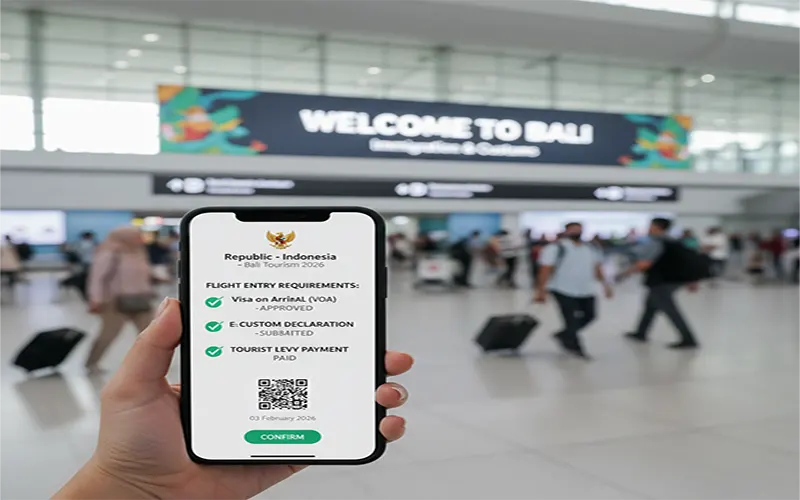
Replacing the fragmented systems of previous years, the All Indonesia Portal is now the mandatory unified platform for all international arrivals. This is not a visa, but a declaration form that must be completed within 72 hours of landing.
This single digital form consolidates three vital components:
- Immigration Declaration: Basic personal and flight data.
- Electronic Customs Declaration (e-CD): Declaring any items, currency over IDR 100 million, or electronic devices for IMEI registration.
- Health & Quarantine Pass: Replaces the old SATUSEHAT system, screening for symptoms and recent travel to endemic regions.
Once submitted, you will receive a QR code. Pro Tip: Take a screenshot of this QR code immediately. While the airport has Wi-Fi, it can be spotty during peak arrival times.
The Bali Tourist Levy (Mandatory)
Introduced to fund cultural preservation and “Green Bali” waste management initiatives, the Bali Tourist Levy is a mandatory fee for all international visitors entering the province.
- The Cost: IDR 150,000 (approximately $10 USD).
- Where to Pay: Use the official Love Bali portal or app.
- The Voucher: After payment, you receive a digital Levy Voucher with a QR code.
- Frequency: This is a per-entry fee. If you leave Bali for a weekend in Singapore and return, you must pay again. However, if you visit neighboring islands like Lombok or Java and return to Bali without leaving Indonesia, you do not pay a second time.
Arrival Walkthrough: Your Step-by-Step Timeline
Navigating the airport in 2026 is a four-step process once you step off the plane:
- Immigration (The Autogates): If you have your e-VOA and a biometric passport, walk straight to the Autogate kiosks. Look into the camera for facial recognition; the gate will open without a physical stamp in your passport (your entry is recorded digitally).
- Baggage Claim: Collect your luggage from the carousels.
- Customs Scan: Before exiting the baggage area, you will reach the Customs checkpoint. Scan your All Indonesia QR code at the scanners. If you have nothing to declare, you will be directed to the exit.
- Tourist Levy Checkpoint: Just before the final exit to the arrivals hall, government officers or automated scanners will verify your Love Bali QR code.
Exemptions & Special Cases
Not everyone is required to pay the IDR 150,000 levy. However, exemptions are rarely “automatic” for foreigners and often require pre-approval through the Love Bali site at least five days before arrival.
- Exempt Groups: KITAS/KITAP holders (residents), Diplomatic/Official visa holders, Student visa holders, and Golden Visa holders.
- ASEAN Travelers: While some ASEAN citizens are visa-exempt, they are not exempt from the Bali Tourist Levy.
2026 Arrival Checklist: Stress-Free Summary
To ensure you aren’t that person frantically searching for a Wi-Fi signal at the customs gate, check off these items before you fly:
- [ ] Passport: 6+ months validity, no physical damage.
- [ ] e-VOA: Applied and paid for at the official Imigrasi website.
- [ ] All Indonesia QR Code: Completed within 3 days of arrival.
- [ ] Love Bali Voucher: Paid and QR code screenshotted.
- [ ] Onward Flight: Proof of departure from Indonesia.
- [ ] Offline Access: All QR codes saved to your “Favorites” photo album.
By following these 2026 protocols, you’ll spend less time in the airport and more time enjoying the sunset in Uluwatu or the rice fields of Ubud. Welcome to Bali!