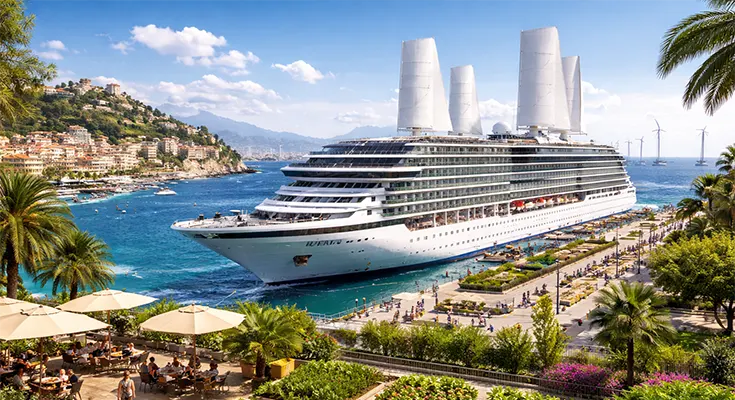
In 2026, “Net Zero” has shifted from a corporate buzzword to a tangible guest experience. The Mediterranean, with its sensitive ecosystems and historic ports like Venice and Dubrovnik, is leading the charge. The “Holy Grail” of this revolution is the Hydrogen Fuel Cell. By converting hydrogen into electricity through a chemical process that emits nothing but pure water vapor, these ships are finally silencing the engines that have hummed in these waters for over a century.
The Pioneer: Viking Libra (December 2026)
Scheduled for her inaugural voyage in late 2026, the Viking Libra is the world’s first cruise ship powered by hydrogen stored on board. While she maintains the elegant, small-ship aesthetic of the Viking fleet, her interior houses a technological marvel.
- Technology: Developed in partnership with Fincantieri, the ship features a 6-megawatt fuel cell system.
- The Impact: The Viking Libra is capable of operating for several hours—including maneuvers in and out of port—with zero emissions.
- Mediterranean Advantage: This allows the ship to access “ultra-low emission zones” in European harbors where traditional diesel-powered ships face increasing restrictions or heavy fines.
The Luxury Segment: Explora Journeys (EXPLORA III)
Joining the Mediterranean fleet in Summer 2026, EXPLORA III represents the luxury segment’s commitment to the “Ocean State of Mind” without the pollution.
- The Hybrid Approach: EXPLORA III and her sister ship, EXPLORA IV (following in 2027), are enlarged versions of their predecessors to accommodate a massive LNG-Hydrogen hybrid system.
- Zero-Emissions in Port: The ship’s 6-megawatt fuel cell is designed to take over the “hotel load” (AC, lighting, kitchens) the moment the ship docks. This means that while you are exploring the streets of Barcelona or Marseille, your ship is sitting at the dock with its massive engines completely turned off, emitting only water.
Technical Spotlight: How Hydrogen Fuel Cells Work
At the core of these 2026 vessels is a PEM (Proton Exchange Membrane) fuel cell. Unlike an engine that burns fuel to create heat and motion, a fuel cell creates a chemical reaction.
- Hydrogen is fed into the anode side.
- Oxygen from the air is fed into the cathode side.
- The reaction produces Electricity to power the propellers and Water as the only byproduct.
Why this matters for you: Beyond the lack of smoke, these ships offer a vibration-free and near-silent sailing experience. You can enjoy a sunset on your balcony without the smell of sulfur or the rhythmic thrum of a diesel generator.
2026 Mediterranean Itinerary Guide
| Ship | Technology | 2026 Primary Route |
| Viking Libra | Full Hydrogen / Hybrid | Western Med (Rome to Barcelona) |
| EXPLORA III | LNG-Hydrogen Hybrid | Eastern Med (Athens to Istanbul) |
| MSC World Europa | Solid Oxide Fuel Cell | Central Med (Genoa, Naples, Valletta) |
The Challenges of 2026: The Infrastructure Hurdle
While the ships are ready, 2026 is a transition year for the ports.
- Green Hydrogen Bunkering: Ports like Marseille Fos and Genoa have just opened their first industrial-scale green hydrogen production units in 2026.
- Liquefied Storage: Storing hydrogen requires extreme cold (-253°C). The Viking Libra utilizes an innovative containerized system, allowing it to swap hydrogen tanks like massive batteries at specialized docks.
The Future of the Blue Med
The ships of 2026 are more than just vacation vessels; they are moving laboratories. Every night you spend on the Viking Libra or EXPLORA III helps fund the scale-up of technology that will eventually decarbonize the entire shipping industry. We are finally entering an era where we can visit the wonders of the Mediterranean while preserving the very water we sail on for the generations that follow.
2026 Eco-Cruiser Glossary
- PEM Fuel Cell: A high-efficiency cell that turns hydrogen into electricity.
- Shore Power: “Cold Ironing”—plugging the ship into the city’s grid to turn off engines in port.
- Green Hydrogen: Hydrogen produced using renewable energy (wind/solar), making it truly 100% carbon-free.