South America’s regenerative model for 2026 focuses on “Integrated Landscapes”—connecting private conservation with public national parks.
1. Patagonia, Chile: The Explora Circuit
The biggest news in 2026 is the completion of Explora’s trans-border circuit. In December 2026, they will launch Explora Torres del Paine Conservation Reserve in Chile and Explora El Calafate in Argentina.
- The Impact: Unlike traditional lodges, the Conservation Reserve is located on a private 70,000-hectare estancia dedicated to rewilding pumas and the rare South Andean deer.
- Outcome: Your stay funds the removal of internal fences, allowing wildlife to migrate freely between the private reserve and the National Park.
2. The Brazilian Amazon: Rio Tapajós
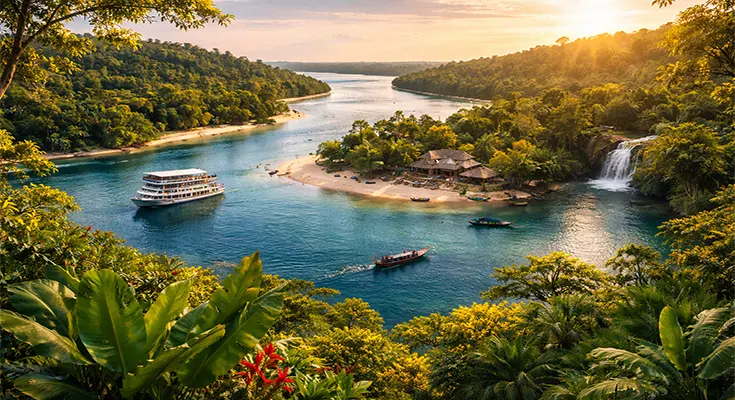
Moving away from the crowded Manaus routes, 2026 sees the rise of Rio Tapajós as the center for indigenous-led regeneration.
- The Experience: Expeditions on riverboats like Kaiara partner directly with the Munduruku people.
- Outcome: Instead of “viewing” communities, guests participate in forest medicine workshops and flour-making traditions. The revenue provides the financial sovereignty needed for these tribes to legally defend their land against illegal logging.
3. The Galápagos, Ecuador: Enchanted Galapagos Lodge
In 2026, “land-based” travel is the preferred regenerative choice over short cruises. Enchanted Galapagos Lodge on Santa Cruz Island has become a model for soil-to-society impact.
- The Impact: The lodge sits on 100 acres of highlands where they are actively replacing invasive guava trees with endemic Scalesia forest.
- Outcome: Guests can participate in reforestation, directly contributing to the habitat restoration for the giant tortoises that roam the property.
African Frontiers
In Africa, the 2026 regenerative frontier is defined by the “Corridor Concept”—reopening ancient migratory paths that have been blocked for decades.
4. Linyanti Wetlands, Namibia: Nkasa Linyanti
Opening in May 2026, Nkasa Linyanti (a Natural Selection camp) is the only lodge on Nkasa Island.
- The Impact: This camp is a “blueprint for wetland recovery.” It sits at the heart of the Kavango-Zambezi Transfrontier Conservation Area, a vital corridor for the world’s largest elephant population.
- Outcome: A significant portion of guest fees is diverted to the Natural Selection Trust, which funds the anti-poaching wardens who protect this cross-border migration route.
5. The Mara Triangle, Kenya: Wilderness Mara
A landmark reopening in June 2026, the new Wilderness Mara (formerly Little Governors’ Camp) has been reimagined with a 100% solar and regenerative mandate.
- The Impact: The camp provides exclusive access to both sides of the Mara River, but its true work is off-site.
- Outcome: In 2026, the lodge’s partnership with the Maasai community ensures that tourism revenue pays for land leases that prevent the conversion of wild savannah into agricultural plots.
6. Greater Kruger, South Africa: Sandringham Private Game Reserve
Perhaps the most ambitious project of 2026 is the transformation of Sandringham into a protected sanctuary.
- The Impact: Formally a hunting reserve, Sandringham (now part of the Sabi Sabi Collection) has undergone a massive five-year rehabilitation.
- Outcome: By mid-2026, the fences between Sandringham and the Timbavati are being dropped, effectively expanding the Greater Kruger wildlife corridor and restoring ancient predator-prey dynamics.
The Regenerative Impact Table (2026)
| Destination | Lodge / Project | Primary Action | Measurable Outcome |
| Chile | Explora Torres del Paine | Puma Habituation | 70k hectares of open range |
| Namibia | Nkasa Linyanti | Corridor Stabilization | Safe passage for 200,000+ elephants |
| Ecuador | Enchanted Galapagos | Invasive Species Removal | Expansion of endemic Scalesia forest |
| South Africa | Sandringham Reserve | Hunting-to-Eco Conversion | Restoration of Big Five habitat |
Science & Ethics: Measuring Success in 2026
Modern regenerative travelers don’t just trust a brochure. In 2026, look for the ‘Biodiversity Net Gain’ (BNG) score—a metric that proves the ecosystem is healthier after a lodge’s operation than it was before. Additionally, the ‘Community Equity’ rating verifies that local indigenous leaders have a seat on the board of the travel company, ensuring social regeneration alongside ecological repair.
The 2026 Ethics Checklist
- Slow Your Pace: Stay at least 7 days in one region to reduce transport carbon and deepen community impact.
- Audit the Supply Chain: Does the lodge source 90%+ of its food within 100km? (Regenerative lodges in 2026 do).
- Electric Only: Prioritize “Silent Safaris” using electric 4x4s and solar-powered boats to reduce noise pollution for wildlife.
Regenerative travel in 2026 is no longer about “leaving only footprints.” It is about leaving behind a thriving forest, a secure migration corridor, and an empowered local community. By choosing Patagonia, the Amazon, or the Linyanti, you are participating in the Earth’s own recovery.